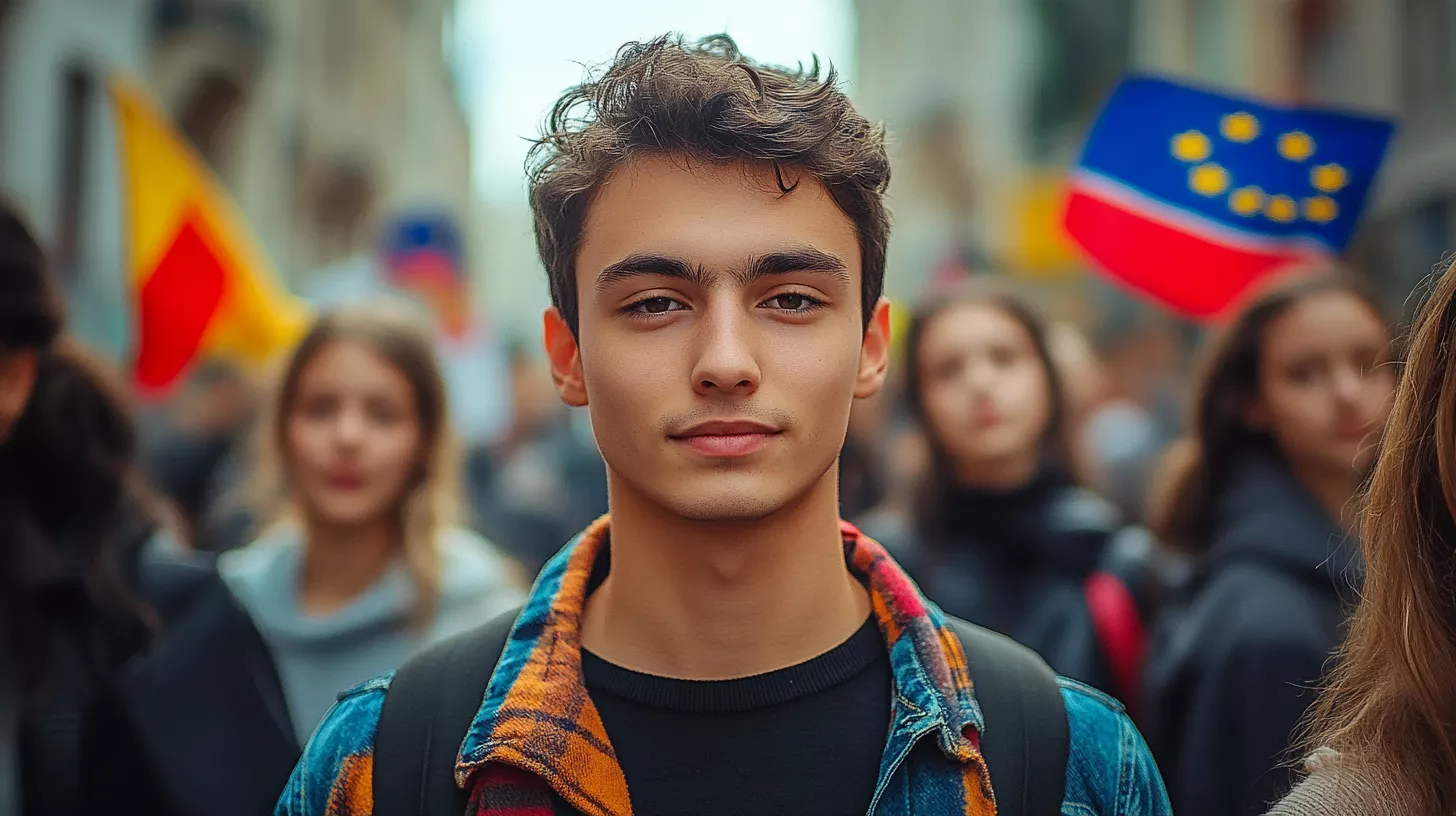
Young people are currently highly visible in protests in several European countries, including France, Belgium, Italy, Spain, Portugal, Albania and Serbia. However, these demonstrations do not form one coordinated European Gen Z movement. Their causes range from education and housing to living costs, public services and institutional accountability. The important pattern is therefore not a single ideology but the simultaneous mobilisation of young people around issues affecting their future.
Why is Gen Z taking to the streets across Europe?
25.10.2026
Benoît Vancauwenberghe
Share on :
Images designed with next-gen intelligence.
Written by Benoît Vancauwenberghe, Gen Z expert, keynote speaker and author of The Gen Z Shift.
Across several European countries, young people are taking to the streets. In France and Belgium, students are protesting over education and public services. In Spain and Portugal, housing and the cost of living are pushing people into squares and protest camps. In Italy, students have joined demonstrations around education, wages and public spending. In Serbia, a student-led movement has turned demands for accountability into a much broader mobilisation. These are not the same protests, and they do not represent one European Gen Z movement. But their simultaneous visibility raises a bigger question: why are so many young people deciding that taking to the streets is one of the ways to be heard? AP News
Before going any further, I want to make two things clear. I do not support violence, vandalism, intimidation or the destruction of other people’s property. Understanding why a protest happens is not the same as excusing everything that happens during it. This is also not an argument against democracy, institutions or the political system, nor is it an academic sociological analysis of social unrest. My work is about understanding younger generations, listening to the signals they send and trying to understand what those signals mean for leaders, organisations and society. And when similar images begin appearing within weeks of each other in Paris, Brussels, Madrid, Lisbon, Milan and elsewhere, I think the signal is worth examining.
Because something interesting is happening. The grievances are local. The politics are different. Yet some of the frustration underneath them sounds surprisingly familiar. And in a generation connected across borders in real time, protest itself may be becoming more portable.
What you will learn in this article
- Why Gen Z is protesting in several European countries
- What these very different movements may have in common
- Why this does not amount to one European “Gen Z revolution”
- How social media can accelerate the visibility and diffusion of protest
- What these demonstrations tell leaders about young people, institutions and the feeling of being heard
Different countries, different anger
Look quickly at Europe in October 2026 and it is tempting to see one big movement. In France, high-school students began blocking and demonstrating over conditions in schools, including understaffing and deteriorating infrastructure. On October 6, the Interior Ministry counted around 266,000 people in demonstrations across the country, while organisers put the figure substantially higher. The movement subsequently broadened, with trade unions and other groups adding demands around living costs and public services. In Belgium, students have protested changes to higher-education funding and tuition fees, while more recent demonstrations have demanded better conditions and investment in education. In Brussels on October 24, hundreds of mostly young demonstrators again took to the streets. Le Monde.fr
Move south and the picture changes. In Spain, housing has become one of the dominant sources of anger, with protest camps appearing in Madrid and other cities as rents and access to housing become increasingly difficult. Portugal has seen housing camps and large demonstrations around wages, pensions and the cost of living. In Italy, students have demonstrated in cities including Rome, Turin, Genoa and Venice, demanding greater investment in education while broader protests have focused on wages, healthcare, housing and living costs. Albania has seen students joining anti-government protests focused particularly on corruption and public services. Serbia offers yet another case: student protests that began after the 2024 Novi Sad railway station canopy collapse developed into a much wider movement demanding accountability and challenging institutional failures. Le Monde.fr
Put those examples next to each other and the first lesson is actually what not to conclude. There is no evidence that millions of European members of Gen Z suddenly woke up with the same political ideology. A Spanish tenant protesting rent is not automatically part of the same political movement as a French student demanding better schools or a Serbian student demanding institutional accountability. Even within individual demonstrations, participants can have very different motivations. Calling all of this a “Gen Z revolution” makes a good headline, but it makes the phenomenon less interesting rather than more understandable.
Different demands, same feeling?
There is, however, another way of looking at these protests. Instead of asking whether young Europeans are fighting for the same thing, ask whether different problems are producing a similar feeling. The latest European Parliament Youth Survey offers an interesting clue. Among Europeans aged 16 to 30, 40% identified rising prices and the cost of living as a priority for the EU, 31% highlighted the economic situation and job creation, 29% social protection and healthcare, 27% education and training, and 23% housing. These are different issues, but they have something important in common: they shape a young person’s ability to imagine the next stage of life. Parlement Européen
We have seen this pattern repeatedly in the subjects we have explored on 20something. Young Europeans have not necessarily stopped wanting the traditional ingredients of adulthood. Many still want meaningful work, independence, relationships, a home and perhaps children. What has changed is the certainty that following the traditional route will deliver them. Education does not guarantee the same employment security. Employment does not automatically make housing affordable. A salary does not necessarily create independence. And working hard does not always produce the visible progression previous generations were told to expect.
This is where I think the protests become more interesting than the individual slogans written on the placards. Perhaps the shared feeling is not simply anger. Perhaps it is a weakening belief in the deal. Study, work, participate, wait your turn, and the system will gradually allow you to build a life. When that sequence becomes less predictable, the question changes from “Why are young people impatient?” to something more uncomfortable: why should they continue trusting a deal if they increasingly doubt the outcome?
That does not mean their diagnosis is always correct. It does not mean every demand is realistic, or that governments can solve housing, education, wages and public services overnight. Previous generations also entered adulthood during recessions, unemployment, wars and enormous social change. But perceptions matter because institutions do not only function through rules. They also function through legitimacy. People need some confidence that participating in the system gives them a meaningful possibility of influencing what happens next.
Maybe Gen Z is not as politically apathetic as we thought
For years, we have heard that young people are disengaged from politics. The evidence has always been more complicated. A 2024 European Commission Eurobarometer found that 48% of young Europeans aged 15 to 30 had taken some form of action to change society, such as signing a petition, attending a rally or contacting a politician. Another European study found that 24% had participated in street protests or demonstrations, while 33% considered demonstrations an effective way of making their voice heard. At the same time, earlier European research found that 70% of young respondents felt they had little or no say over important decisions affecting the EU. European Commission
That combination is important. Feeling politically powerless does not necessarily produce political apathy. Sometimes it produces a search for different forms of political agency. A person can have little attachment to a political party and still care deeply about housing. They can distrust institutions and still believe strongly in democracy. They can ignore a parliamentary debate and spend Saturday afternoon in a demonstration. Institutional participation and political interest are not the same thing.
This is why I would be careful with the idea that young people are taking to the streets because they have stopped believing in politics. The opposite interpretation is at least worth considering. Maybe some young people are protesting precisely because they still believe politics should produce results. A demonstration is not necessarily withdrawal from democratic life. Peaceful protest is itself one of the ways democratic societies allow citizens to express disagreement. The problem for institutions begins when people conclude that the formal channels available to them are not sufficient to make their concerns visible.
Protest now travels at the speed of a feed
And then we arrive at what I find most fascinating about the current moment. Why do movements that have different causes suddenly appear so visible across different countries at roughly the same time? There is an easy answer: social media. But “TikTok made them protest” would be about as useful as saying television caused May 1968.
Social media does something subtler. It dramatically reduces the distance between one protest and another. For 42% of Europeans aged 16 to 30, social media is already their primary source of information about political and social issues. Eurostat also found that 24.3% of Europeans aged 16 to 29 engaged with civic or political issues online in 2025, a higher proportion than in the overall population. A protest that once might have been a local story reported the following evening on national television can now become part of a young European’s feed while it is happening. Parlement Européen
And what travels through that feed is not only information. It is imagery, language, emotion and method. You see how another group organises. You see their banners. You see which symbols work. You see a school being occupied, a square filling with tents, a march suddenly attracting thousands of people. You see how authorities respond. You see what goes viral. Most importantly, perhaps, you see that people like you decided to do something.
Research on protest diffusion suggests that movements can indeed learn from and emulate movements elsewhere, although the evidence also gives us an important warning: diffusion is often strongest across neighbouring countries and does not mean that a single protest wave automatically sweeps an entire continent. Research on digital activism similarly shows that online and offline mobilisation increasingly reinforce one another. Social networks can facilitate the spread of protest, but they can also intensify polarisation and amplify more radical content. In other words, digital platforms are neither the origin of every grievance nor politically neutral pipes through which grievances travel. Cambridge University Press
I would describe what may be happening as a sequence: a local grievance becomes visible, someone elsewhere recognises part of their own frustration in it, the form of mobilisation becomes imaginable, and that form is then adapted to a different local problem. The Spanish protest does not need to have the same demand as the French protest for one to influence the imagination of the other. The grievance does not have to travel. The repertoire of protest can.
That is why I am reluctant to call what we are seeing a European Gen Z movement. A better description might be portable protest. Economic and institutional pressures provide the frustration. Digital networks provide visibility and sometimes speed. Local actors then decide what to do with it.
Violence can become the wrong story
There is another reason why we need to distinguish carefully between protest and violence. Recent demonstrations in France, Belgium and Italy have included serious incidents involving vandalism, fires, projectiles, looting and clashes with police. Those acts should not be minimised. But neither should they automatically be used to define every person who was present. In France, hundreds of thousands participated in demonstrations that were largely peaceful even as serious violence occurred around some of them. In Italy, authorities and reporting have also distinguished between broader demonstrations and smaller groups involved in violent incidents. In Belgium, the demonstrations on October 24 were considerably smaller and less violent than the unrest of the previous weekend. AP News
Violence also has a strange effect on our understanding of youth protest because it is visually irresistible. A burning scooter will always make better footage than 5,000 people walking peacefully behind a banner. The danger is that the most spectacular image becomes our explanation of the entire event. Then the conversation shifts from Why are these people here? to Look what these people did. Sometimes that shift is completely justified because public safety matters. But if we stop there, we may miss the signal that brought thousands of peaceful participants into the street in the first place.
Understanding is not approval. It is possible to condemn violence unequivocally while still asking what produced the mobilisation around it. In fact, leaders should probably be doing both.
The real warning for leaders is not the protest
For business leaders, employers, educators and political institutions, the interesting part of this story is therefore not whether they agree with every placard. It is what happens when a generation begins to feel that conventional mechanisms are too slow, too distant or too ineffective to respond to the problems shaping its future. The worst response would be to dismiss every young protester as radical, entitled or manipulated by social media. The second worst would be to romanticise the protests as proof that an entire generation is heroically rising up. Neither interpretation helps us understand what is actually happening.
The better question is: what signal are we receiving? Housing, education, employment, purchasing power and public services repeatedly appear in young Europeans’ stated concerns. Those are not abstract ideological questions. They determine whether people can study, leave home, find work, build relationships and imagine a future. When young people feel that those foundations are becoming less secure while also feeling that their influence over decision-making is limited, protest becomes easier to understand, even when we disagree with particular demands or methods.
For leaders, that should matter beyond politics. The same generation entering the streets is entering organisations. If young employees feel decisions are made somewhere above them, explanations arrive after the decision, and speaking up changes nothing, the reaction will not necessarily be a demonstration outside headquarters. It might be disengagement, departure, refusal, cynicism or simply silence. Different behaviour, similar signal: I do not believe my voice changes anything.
So why is Gen Z taking to the streets across Europe?
There is no single European Gen Z revolt. The evidence does not support that conclusion. France is not Belgium, Belgium is not Spain, Spain is not Serbia, and the people participating in these demonstrations cannot be reduced to one generation or one political worldview. Research on protest diffusion also warns against assuming that simultaneous protests automatically constitute one transnational movement. Cambridge University Press
But dismissing the similarities would be equally unhelpful. Across several European countries, young people are expressing frustration around the conditions that determine whether they can move forward: education, work, housing, purchasing power, public services, accountability and political voice. At the same time, they belong to the first generation for whom another country’s protest can appear on the same screen, in the same feed and on the same morning as a video from a friend.
That changes something. Not necessarily what young people are angry about, but how quickly they can recognise that anger in others and how quickly they can see a possible way of expressing it.
Maybe that is the real shift we should be watching. The grievances remain local. The politics remain national. The solutions will often have to be specific. But the language, imagery and repertoire of protest can increasingly cross borders before institutions have even finished explaining what happened in the first country.
The anger is local. The language is becoming European.
Q&A
There is no single cause. European surveys show that young people are particularly concerned about the cost of living, employment, climate, social protection, education and housing. Recent demonstrations reflect different combinations of those pressures depending on the country. A broader factor may be the perception among some young people that traditional institutions are not responding quickly enough to the issues shaping their transition into adulthood.
There is no evidence that social media alone causes young people to protest. Research does show, however, that digital networks can help information, protest tactics and mobilisation spread between communities. Social media is also now the main source of political and social information for many young Europeans. It is therefore better understood as an accelerator of visibility and mobilisation than as the original source of the grievance. Parlement Européen
The evidence suggests a more complicated picture. In a 2024 European Commission survey, 48% of 15 to 30-year-olds said they had taken action to change society through activities such as signing petitions, attending rallies or contacting politicians. Young people may be less attached to some traditional forms of political participation while remaining active around particular causes. Protest can therefore be a form of political engagement rather than evidence of political apathy. European Commission
Bring the Gen Z shift into your leadership team
Understanding Gen Z is not about learning a new collection of stereotypes. It is about recognising the signals behind changing behaviour before those signals become organisational problems. Through keynotes, leadership workshops and generational research, 20something helps leaders understand what younger generations are telling them about work, authority, trust and the future, and translate those insights into action.
From a 45-minute keynote to a full-day leadership workshop, we can bring these questions directly into your organisation. They are also at the heart of my book, The Gen Z Shift: Why Today’s Leaders Keep Acting on the Wrong Signals. More information about the book is available on The Gen Z Shift.


You may also like these articles
Explore our collection of articles decoding youth culture, Gen Z, and Gen Alpha.