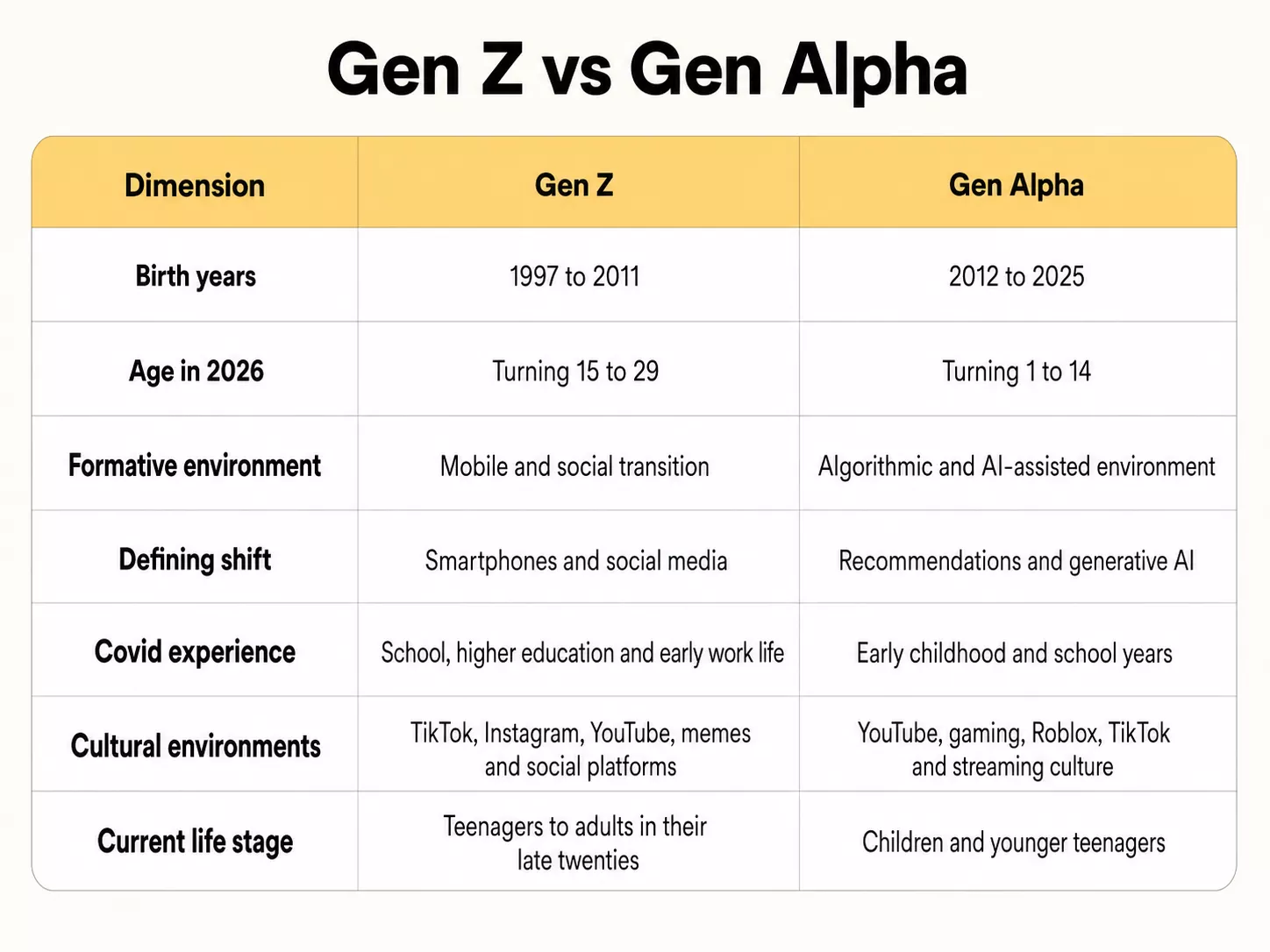
Gen Z experienced the transition towards smartphones, social media and mobile communication during its formative years. Gen Alpha is growing up after mobile connectivity became part of childhood’s basic infrastructure, while algorithmic recommendations and generative AI are entering education and everyday life.
Gen Z and Generation Alpha : the real differences between the two generations
Share on :
Images designed with next-gen intelligence.

Most read
Written by Benoît Vancauwenberghe, a European expert on Generation Z, Generation Alpha, and generational strategy, a keynote speaker, and author of The Gen Z Shift.
What is the real difference between Gen Z and Gen Alpha?
The easy answer is age. Gen Z came first; Gen Alpha came next. The more useful answer is context. Gen Z experienced the transition towards smartphones, social media, and a permanently connected life during its formative years. Gen Alpha is growing up after mobile connectivity became part of the basic infrastructure of childhood, while another transformation towards algorithmic recommendations and generative AI is underway. The difference is not simply how much technology they use. It is the developmental moment at which that technology entered their lives. Gen Z experienced the digital transition. Gen Alpha was born into its infrastructure.
This article explores:
- The key differences between Gen Z and Gen Alpha
- How mobile technology, algorithms, and AI shaped them differently
- Why generational boundaries remain flexible
- How COVID and digital culture affected each generation
- What leaders can conclude, and what is still too early to predict
Gen Z and Gen Alpha definitions.
A commonly used definition places Gen Z between 1997 and 2012. Mark McCrindle’s framework defines Gen Alpha as those born between 2010 and 2024, which overlaps with some popular classifications. That overlap is not a mistake. It reveals that generational boundaries are conventions rather than scientifically fixed borders.
Where does Gen Z end and Gen Alpha begin?
There is no universally recognized institution that officially decides when one generation ends and another begins. Pew Research Center uses 1996 as the final Millennial birth year and considers people born from 1997 onwards part of the next generation. It has also become more cautious about applying rigid labels, arguing that generational analysis must distinguish between the effects of age, historical events, and genuine differences between birth cohorts.
Mark McCrindle uses a different 15-year system:
- Gen Z: 1995 to 2009
- Gen Alpha: 2010 to 2024
- Gen Beta: 2025 to 2039
He developed and popularised the term Generation Alpha to describe the first cohort born entirely in the 21st century. Which definition is correct? That is the wrong question. Generational boundaries help organize a discussion. They are not scientific borders. A person born in December 2009 does not operate through a fundamentally different cultural system from someone born in January 2010. Generational change happens gradually. Technologies spread at different speeds. Families adopt them differently. Countries have different education systems, regulations, cultures, and levels of access. The dates are useful. They are not destiny.
Maybe you’ll like this article too: What is Gen Z? Why they are not Millennials 2.0
Gen Z experienced the mobile shift
Gen Z grew up during a period of profound digital transition. Many older members remember shared computers, limited mobile data, and a childhood in which being permanently online was not yet the default. Younger members encountered smartphones and visual platforms much earlier. Across the generations, however, mobile technology increasingly moved from being a device into becoming an environment. In my work, I describe this as the shift towards a mobile childhood.
The smartphone brought several changes together:
- permanent connectivity
- front-facing cameras
- notifications
- visual social platforms
- public indicators of popularity
- personalised feeds
- the possibility of documenting everyday life
Gen Z did not simply receive new tools. They had to learn how to build identity, communicate, compare themselves and negotiate social status inside an environment that had become more visible, measurable and permanent. Pew has described Gen Z as having little or no memory of the world before smartphones. But even this statement needs nuance. A person born in 1997 experienced the mobile shift differently from someone born in 2011. There is not one perfectly homogeneous Gen Z childhood. There is, however, a shared generational transition. For a deeper exploration, read What is Gen Z? Why they are not Millennials 2.0.
Gen Alpha was born into the infrastructure
For Gen Alpha, mobile technology is no longer the main disruption. Touchscreens, streaming, video on demand, connected gaming, visual communication and personalised recommendations existed before many Alpha children could read or speak. They do not remember society becoming mobile.
They entered a society that already was. Gen Z watched the digital world become mobile. Gen Alpha entered a world where mobile was already the default.
This does not mean that all Alpha children have equal access to devices, platforms, or connectivity. Geography, income, education and parenting still produce radically different childhoods. But digital media now form part of how many children learn, play, communicate, and explore independence. The OECD stresses that digital childhood includes both opportunities and risks, and that outcomes depend heavily on the child’s wider offline circumstances. The technology is becoming less visible as it becomes increasingly embedded in everyday life. Like electricity, children often notice it most when it stops working.
From search culture to recommendation culture
One of the most interesting differences between Gen Z and Gen Alpha is how they encounter information. Gen Z grew up with Google, YouTube searches, hashtags, and social search. Finding something usually started with a deliberate action: typing a question, choosing a link, or following a trail. Gen Alpha is increasingly growing up in recommendation-first environments.
Videos, songs, games, and creators can appear before the child has formulated a request. The system predicts what might maintain attention and places it directly into the feed. A simple way to describe the shift is: Gen Z learned to search. Gen Alpha is increasingly growing up being recommended to.
This does not mean that Gen Alpha is passive or that active searching will disappear. Children explore, create, play, communicate, and make choices across digital environments. But algorithmic systems increasingly influence the starting point. They shape what becomes visible, what is repeated, and what feels culturally important. Over time, this may influence how young people approach discovery, attention, curiosity, and information gathering. That remains a field to study, not a conclusion to exaggerate.
More digital access, but not necessarily more independence
It is tempting to assume that greater access to technology gives children greater freedom. The reality is more complicated. Gen Alpha may be growing up inside one of the most technologically mediated childhood environments we have seen.
Many children encounter:
- parental control applications
- screen-time limits
- location tracking
- connected watches
- digital school portals
- content filters
- platform safety measures
- increasing regulation of children’s online experiences
Ofcom’s research examines not only children’s media use but also how parents monitor and manage it. This matters because the child’s digital experience cannot be separated from the rules, fears and expectations of the adults surrounding them. This creates a paradox: more digital access does not necessarily mean greater independence.
Gen Alpha can access an enormous amount of information and entertainment, while being more closely observed across both digital and physical spaces. Their childhood is shaped by expanding possibilities, but also by growing adult concern around safety, privacy, well-being and screen use.
AI arrived at different moments
The public release of ChatGPT in November 2022 accelerated the mainstream adoption of generative AI. For most of Gen Z, generative AI arrived during secondary or higher education, or at the start of working life. It disrupted existing habits. Students had to reconsider how they researched and produced assignments. Young professionals began questioning which skills would remain valuable. Employers started debating productivity, automation, and the future of entry-level work. For Gen Alpha, the timing is different. AI is entering search engines, learning platforms, creative tools, and educational environments while the generation is still at school. For Gen Z, AI is a disruption. For Gen Alpha, it may become an educational environment.
The OECD’s 2026 Digital Education Outlook concludes that generative AI can support learning when it is connected to clear educational goals, appropriate design and human guidance. It also emphasises the need for safety, AI literacy, trust and teacher involvement. This is why the term AI native should be used carefully. Using AI from an early age does not automatically mean understanding:
- How the system works
- where the information comes from
- Why does it produce errors
- What data does it collect
- When its answers should be challenged
Familiarity is not the same as literacy. A child can be fluent with an interface and still lack the critical distance needed to understand the system behind it.
COVID shaped them at different life stages
COVID affected both generations, but not in the same way. Many members of Gen Z experienced the pandemic during adolescence, university, or the transition into employment. It interrupted social milestones, education, mobility, and the beginning of professional independence. Gen Alpha’s experience was more fragmented. The oldest members experienced school closures during early childhood or their first school years. The youngest will have no direct memory of the pandemic.
UNICEF reported that schools serving more than 168 million children globally were closed for almost a full year during the first year of the crisis. It is also estimated that at least 463 million children could not access remote learning during school closures in 2020. For older Alpha children, lockdowns disrupted classroom learning, routines and face-to-face social interaction. For younger Alpha children, COVID will be a historical story told by parents and teachers. This difference exists within the same generation. It is another reminder that Gen Alpha cannot be treated as one homogeneous group.
Frequently asked questions about Gen Z vs Gen Alpha
Definitions vary. A commonly used classification places Gen Z between 1997 and 2012. Mark McCrindle’s framework places Gen Z between 1995 and 2009 and Gen Alpha between 2010 and 2024. These boundaries are conventions, not scientifically fixed borders.
Not necessarily. The main difference is not simply how much technology the generations use. It is the age and developmental context in which particular technologies became normal.
Gen Alpha may become the first generation whose education is substantially influenced by generative AI from childhood. However, access and usage will differ, and early exposure does not automatically produce AI literacy or critical understanding.
Many Gen Z members encountered smartphones and social media during childhood or adolescence, but the timing varied significantly between the oldest and youngest members of the generation.
Yes. They share mobile platforms, visual communication, online entertainment and many cultural references. The key difference is that these systems entered their lives at different developmental moments.
No. In 2026, Gen Alpha is still mainly composed of children and younger teenagers. Claims about their future workplace behaviour remain speculative.
Understand the generational shift inside your organisation
Understanding Gen Z and Gen Alpha requires more than comparing birth years or following the latest digital trends. It means recognizing how different formative environments shape communication, trust, learning, and expectations.
In his keynotes, Benoît Vancauwenberghe helps brands and leaders decode these generational signals and translate them into clearer strategy, stronger communication, and more relevant leadership.


You may also like these articles
Explore our collection of articles decoding youth culture, Gen Z, and Gen Alpha.