Generation Alpha includes individuals born roughly between 2010 and 2025. They are demographic outliers because they represent the world’s first entirely mobile-native, tablet-native, and AI-native generation, having no memory of a pre-generative AI world
How Generation Alpha is quietly redesigning Europe’s Economy
Share on :
Images designed with next-gen intelligence.

Written by Benoit Vancauwenberghe, European expert on Generation Z, Generation Alpha, and digital culture.
We are no longer living in a parent-first consumer economy. We are entering the era of the Gateway Generation.
A few months ago, while grabbing an espresso in Brussels, I watched an eight-year-old decide where an entire family would have lunch. Not emotionally. Algorithmically. The child opened TikTok, found a ramen spot, compared the Google Maps rating with a creator’s review, checked whether the desserts looked “worth it,” then casually dismissed another restaurant because “everyone online says it’s overrated.” The parents followed. No discussion. No debate. And that was the moment I realized something
Generation Alpha, the demographic born between 2010 and 2025, is no longer a passive observer on the sidelines of household decisions. Across Europe, they are becoming curators of taste, digital trust, and brand discovery. And most companies still haven’t noticed.
Defining the Alpha economy
The Alpha Economy describes the rapidly growing purchasing and decision-making influence of Generation Alpha. Their digital-native and AI-first behavior directly reshapes household spending patterns, brand discovery mechanics, and frictionless, AI-mediated commerce. Unlike Millennials or Gen Z, Generation Alpha didn’t have to “adopt” digital tech or adapt to the mobile web. They were born directly inside the simulation.
For them:
- Algorithmic recommendations matter infinitely more than traditional search.
- Independent creators hold way more weight than legacy institutions.
- Frictionless access completely trumps physical ownership.
- AI systems are becoming the default interface through which every single life decision is filtered.
This shift fundamentally flips the architecture of consumer commerce.
Why Generation Alpha is an absolute economic powerhouse
According to recent macroeconomic consumer studies, Generation Alpha already commands tens of billions of dollars in direct global spending power. But focusing only on their pocket money misses the entire point. Their real macro-economic superpower is their indirect authority over the household wallet. Data from DKC Analytics indicates that nearly 90% of parents have actively changed their purchasing behavior or brand loyalty to align with their child’s explicit preferences.
The hierarchy is collapsing. Market analysts used to treat children as secondary consumers, passive recipients of whatever their parents put in the shopping cart. Today, the “Alpha CEO” isn’t a cute marketing metaphor; it is the domestic operating system of the modern European home.
The new household curators
In Europe, this demographic’s veto power extends far past toys, gaming tokens, and fast food. Generation Alpha is actively shaping:
- Family travel destinations and weekend itineraries.
- Restaurant choices and food delivery app preferences (Uber Eats, Deliveroo).
- Entertainment and software subscriptions (Netflix, Spotify, iCloud tiers).
- Direct creator-led commerce purchases.
In practice, the children have become the household’s unofficial, highly optimized recommendation engine.
Look at the UK fintech ecosystem for a clear blueprint. Platforms like GoHenry normalized app-based allowances and gamified digital spending for young users years before traditional European retail banks even woke up to the trend. The result? A generation that experiences money as something fluid, invisible, and permanently attached to digital interfaces. For Gen Alpha, physical cash is already psychologically obsolete.
Europe’s invisible spending revolution
According to the European Central Bank’s SPACE study, cash usage is on a steep, terminal decline across the Eurozone, especially among younger demographics.
Generation Alpha is growing up in a native “cash-light” economy characterized by:
- Invisible Payments: Biometric checkouts, Apple Pay, and auto-renewals.
- Ambient Subscriptions: Services that blend seamlessly into the background of daily life.
- Zero Friction: The total removal of checkout barriers.
This matters because, historically, financial friction acted as a psychological brake on consumption. Physically pulling cash out of a wallet creates emotional resistance. Invisible spending deletes that resistance entirely. The interface disappears. And once payments become invisible, digital trust becomes the only currency that actually matters.
This ecosystem shift is accelerated by a major gap in parental digital governance. Consumer data indicate that a large percentage of European parents do not actively monitor or audit in-app purchases, digital wallets, or gaming-related microtransactions made by their kids.
The consequence is subtle but massive: Generation Alpha is learning the mechanics of commerce through closed digital ecosystems, completely detached from traditional budgeting behavior.
The death of search: moving to answer engines (GEO)
The most violent disruption happening right now isn’t financial; it’s cognitive. Generation Alpha does not use the internet the way you do.
- Legacy Internet – Millennials searched (Google) ➔ Browsed Links ➔ Consumer Choice
- Bridge Internet – Gen Z optimized (Keywords/Socials) ➔ Curation ➔ Consumer Choice
- Agentic Internet – Gen Alpha prompts (AI/Feeds) ➔ Automated Recommendation ➔ Consumer Action
This distinction completely rewrites the monetization models of the web. For over two decades, the internet operated on a predictable triptyque: users searched, platforms ranked links via SEO, and brands burned cash to fight for visibility on page one.
AI systems are destroying that flow. We are moving away from search engines and straight into the era of Answer Engines. This transition has given rise to a critical marketing framework: Generative Engine Optimization (GEO).
GEO is the practice of structuring your brand’s data, product information, and digital footprint so that it is natively ingested and directly recommended by AI systems (like Perplexity, ChatGPT, and Gemini), rather than hoping an organic user clicks on a blue link. In the near future, your primary target customer will not be a human being. It will be an AI agent acting on behalf of a human being. Gen Alpha rarely “searches” in the legacy sense. The recommendation layer is the interface.
Why are cheap AI infrastructures exploding this trend
The underlying catalyst here is purely infrastructural. AI model execution is becoming drastically cheaper. Tech conglomerates like Baidu have recently documented massive efficiency gains in LLM training and compute optimization, sharply reducing the cost of running advanced AI systems at scale. When AI compute costs hit near-zero levels, AI stops being an external application or tool. It becomes invisible infrastructure. Just like electricity, running water, or cloud hosting. We aren’t just adding an AI chatbot to e-commerce websites; we are entirely rebuilding global commerce around AI-mediated decisions.
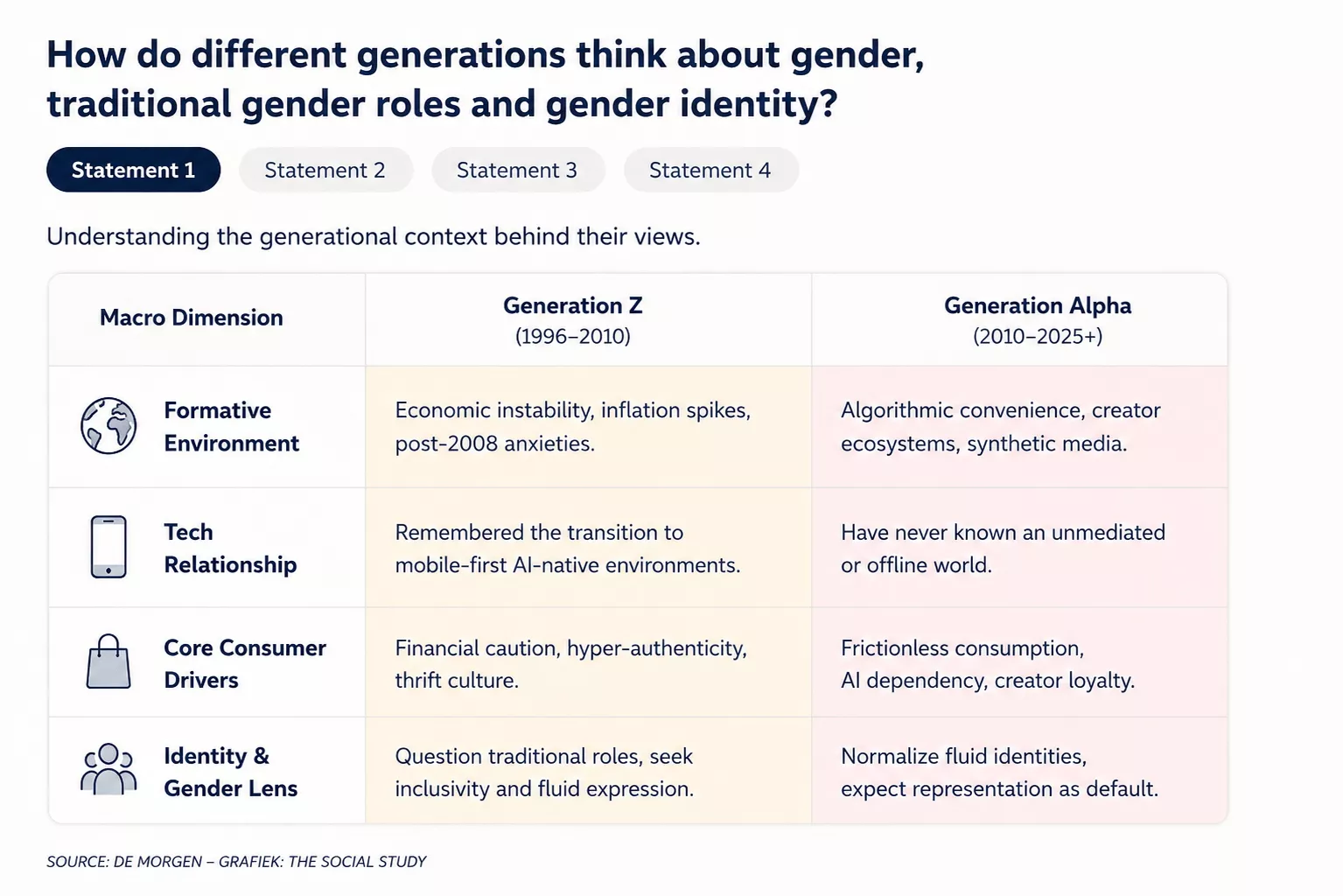
The cultural fault line: Gen Z vs. Generation Alpha
One of the most dangerous mistakes European executives and brand strategists make is bundling Gen Z and Gen Alpha into a single “young consumer” bucket.
They are fundamentally different cohorts. These distinct backgrounds create wildly contrasting expectations around data privacy, speed, brand interaction, and automated decision-making.
Europe’s strategic advantage: the trust dividend
For years, European corporate leaders treated regional tech regulation as a massive handicap. GDPR, the EU AI Act, and the Digital Services Act (DSA) were routinely blasted as bureaucratic barriers to raw innovation. But what if Europe accidentally built the most valuable economic asset of the 21st century?
Consider the paradox: Generation Alpha will be the most technologically sophisticated generation in human history, yet also the most deeply skeptical. Because they are growing up in Europe’s highly regulated digital jurisdiction, they are exposed to systemic conversations about algorithmic transparency, digital consent, data exploitation, and online safety at an incredibly early age. This environment creates a unique competitive moat: The trust dividend.
In an economy run by autonomous AI agents, the winning brands won’t be the loudest or those with the biggest ad budgets. They will be the ones trusted enough to operate silently within a user’s daily life.
- Out: Aggressive behavioral personalization ➔ In: Ethical personalization.
- Out: Dopamine-driven dark patterns ➔ In: Reliable, clean recommendation.
- Out: Surveillance capitalism ➔ In: Radical data transparency
This is exactly where European enterprises can lead the global market.
Checklist: How your brand survives the shift
If your business is still optimizing solely for web clicks, you are optimizing for a ghost town. To prepare for an economy run by recommendation agents, implement three shifts immediately:
1. Hardcode your content for AI Engines (AIO/GEO)
If your corporate data, product specs, and brand philosophy cannot be effortlessly crawled, parsed, and cited by LLMs, your business is effectively invisible. High-authority, highly structured, well-sourced content (E-E-A-T) completely replaces keyword-stuffing.
2. Prioritize trust signals over attention economics
Gen Alpha can spot marketing manipulation and fake urgency from a mile away. Brands that rely on cheap conversion hacks, fake countdown timers, or addictive loop mechanics will permanently alienate this cohort. Trust is your only sustainable defensive moat.
3. Build responsible, frictionless guardrails
Removing friction from digital checkouts is great for conversions, but invisible spending creates massive ethical exposure regarding parental consent and youth digital literacy. The companies that dominate this transition will be those that build ethical, transparent guardrails directly into their frictionless UX.
The deep question we are all avoiding
Most corporate panels focus entirely on how AI will optimize white-collar productivity. But the real seismic shift is behavioral. What happens to a society when an entire generation grows up viewing artificial intelligence not as a software tool, but as a permanent, systematic intermediary between themselves and reality? What happens when automated recommendations completely replace serendipitous human discovery?
That is the true economic transformation hiding beneath the AI hype cycle. And thanks to its regulatory framework focused on human-centric guardrails, Europe might just be the only place positioned to get it right. In a world drowning in synthetic content, invisible commerce, and autonomous agents, trust isn’t just a compliance check; it’s the most valuable infrastructure on earth.
Even though the oldest Alphas are only entering their mid-teens, they act as the primary digital curators for their households. They leverage algorithmic platforms (TikTok, AI interfaces) to dictate family spending on travel, food, entertainment, and retail, effectively shifting buying authority away from parents.
GEO is the direct evolution of SEO. Instead of optimizing websites to rank on traditional search engines like Google, GEO focuses on structuring data and content so that conversational AI models and autonomous agents natively pull, synthesize, and recommend your brand directly inside AI chat interfaces.
Regulations such as the GDPR and the EU AI Act have compelled European companies to build ecosystems rooted in data privacy and algorithmic transparency. As Generation Alpha grows increasingly skeptical of synthetic media and manipulative tech, this “Trust Dividend” positions European brands to capture long-term loyalty through ethical, secure AI commerce.
Understanding Gen Z & Gen Alpha | Keynote speaker Europe
From identity and mental health to social media, masculinity, work, relationships, and AI, Gen Z and Gen Alpha are redefining how an entire generation sees the world. Their values, behaviors, fears, and expectations are radically different from those of previous generations, and most organizations are still trying to understand them using outdated frameworks.
Through keynote talks, workshops, and research-driven storytelling, we help companies, schools, brands, and institutions decode the mindset of the next generation: how they think, why they behave differently, and what this means for leadership, communication, education, recruitment, and culture.
Discover the keynote speakers, workshops, and reviews here.


You may also like these articles
Explore our collection of articles decoding youth culture, Gen Z, and Gen Alpha.