Researchers say many Gen Z men are becoming more conservative because of a combination of social media influence, economic uncertainty, identity anxiety, and exposure to manosphere content online. Studies from organizations like KU Leuven suggest that platforms such as TikTok, YouTube, and Instagram increasingly amplify traditional masculinity narratives and anti-feminist messaging through recommendation algorithms.
Why are Gen Z and Millennial men becoming more conservative?
10.05.2026
Benoît Vancauwenberghe
534
Share on :
Images designed with next-gen intelligence.

Most read
A reality TV reality check
“Doing the household chores is part of it,” muttered Rey, a 31-year-old participant on the reality program Temptation Island, during a recent campfire segment. When the host, stunned, asked what exactly chores were a part of, Rey’s response was bone-dry and absolute: “Being a woman.”
In years past, such a statement might have been relegated to the darkest, most isolated corners of the internet. Today, it is primetime fodder. We are witnessing a seismic shift where blatant misogyny is no longer a fringe subculture—it is being normalized on our screens and in our social feeds. This isn’t just a “reality TV moment”; it is a symptom of a documented resurgence of conservative gender roles among young men. A comprehensive study from KU Leuven, surveying over 4,000 Belgians, confirms that the ideological chasm between young men and women is not just wide, it’s cracking open.
Takeaway 1: The widening generational gap
The prevailing cultural narrative suggests that progress is linear—that each generation is naturally more “woke” or progressive than the last. The KU Leuven data shatters this illusion. When it comes to gender identity, Gen Z and Millennial men are significantly more traditionalist than the Baby Boomers who preceded them.
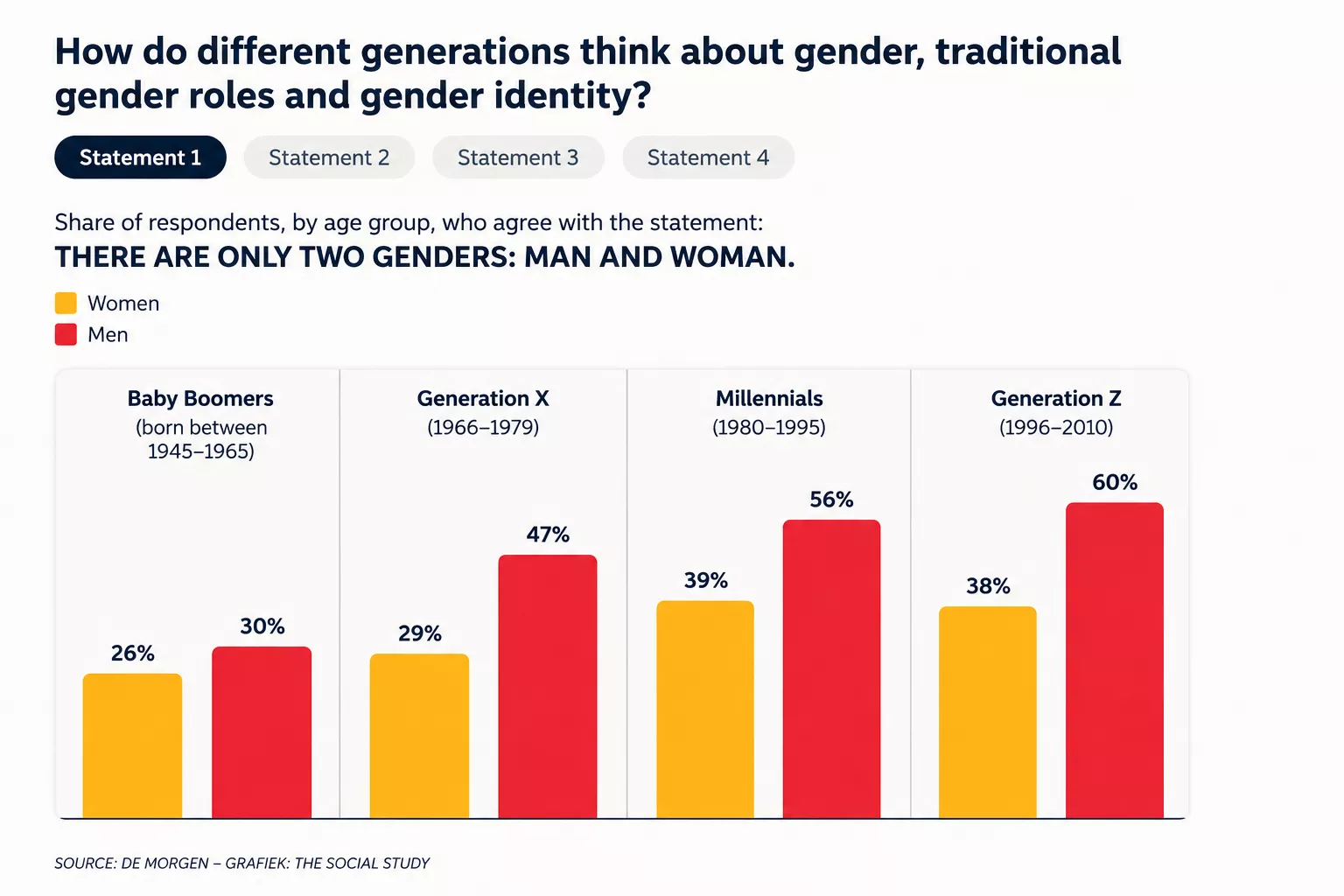
Percentage of Respondents Agreeing: “There are only two genders: male and female.”
|
Generation (Birth Years)
|
Women
|
Men
|
|---|---|---|
|
Gen Z (1996–2010)
|
38%
|
60%
|
|
Millennials (1980–1995)
|
39%
|
56%
|
|
Gen X (1966–1979)
|
29%
|
47%
|
|
Baby Boomers (1945–1965)
|
26%
|
30%
|
The “headline” here is jarring: Gen Z men are twice as likely as Baby Boomer men to hold a binary view of gender. However, sociologist Cecil Meeusen provides a critical analytical nuance: we must distinguish between a generation effect and an age effect. While younger cohorts in the 90s and 2000s also showed conservative streaks before “mellowing” with age, the current data shows that the rift, specifically between young men and young women, is expanding at an unprecedented rate. We aren’t just seeing a phase; we are seeing a divergence.
Takeaway 2: the “Manosphere” and the big bad wolf
Social media is no longer just a communication tool; in the context of identity formation, it has become the “big bad wolf.” For young men navigating the uncertainties of early adulthood, algorithms act as predatory curators, steering them toward the “manosphere”—a digital ecosystem of resentment.
These platforms prey on insecurity, offering traditionalism as a cure for modern alienation. The cultural weight of this shift is reflected in recent media, including Louis Theroux’s 2026 Netflix documentary Inside the Manosphere and the 2025 series Adolescence, both of which illustrate how deeply these misogynistic frameworks are being hardcoded into the male psyche.
“Subcultures such as the manosphere share misogynistic content and ideas about masculinity and gender norms, and play on their insecurity or frustration. And algorithms reinforce that spread even more.” — Cecil Meeusen, Sociologist.
Takeaway 3: The “Gender Backlash” and manufactured politics
This pivot to tradition is a classic “gender backlash”—a defensive crouch in response to the rapid gains women have made in education and the workplace. As women assertively claim space, many men perceive a loss of social equilibrium. Movements like #MeToo have acted as catalysts, making some men feel that their status is under siege.
However, as a social analyst, I must point out that this shift isn’t purely organic. We are seeing the rise of a sophisticated “anti-gender movement.” This is an organized, well-funded political machine that has moved beyond simple protests. They are now weaponizing fake news, conspiracy theories, and online hate to polarize the gender debate and influence elections. The “tradition” these men are pivoting toward is being politically manufactured and sold to them as a rebellion.
Takeaway 4: The rise of “Equality Fatigue” and victim blaming
The normalization of these views leads directly to a toxic culture of “victim blaming.” The data is damning: one in five Gen Z men now believe that women exaggerate the problems and harassment they experience in the workplace.
This sentiment is fueled by what sociologists call moeheid—equality fatigue. It’s the idea that the constant demand for equal rights is no longer a human rights pursuit but a “nagging” (zeuren) annoyance. We saw this friction play out vividly in the interaction between Bart Schols and Soundos El Ahmadi on De Afspraak, where legitimate concerns about women’s safety were met with defensive irritation. When the quest for basic safety and equity is reframed as “complaining,” hard-won progress is at immediate risk of being rolled back.
Takeaway 5: The hidden cost for men and the education crisis
The irony of this traditionalist pivot is that it traps men in the very roles that cause them harm. By forcing themselves back into rigid, outdated boxes, young men face:
- Crushing performance pressure.
- Paralyzing insecurity regarding their “value.”
- Severe, unaddressed mental health struggles.
The solution, according to experts, is controlled, relational education. Yet, we face a systemic obstacle: the Flemish government has recently scaled back the minimum goals for relational and sexual education in schools.
By retreating from the classroom, the state is effectively surrendering young minds to the unregulated wild west of social media, where radicalization and fake news fill the vacuum left by missing curriculum.
Conclusion: A polarized path forward
The KU Leuven study is a warning light on the dashboard of our society. While Belgian legislation may not regress overnight, the “real” risk of far-reaching polarization and radicalization is already here. We are moving toward a future where men and women don’t just disagree on politics—they live in different moral universes.
Attitudes eventually translate into behaviors. If we continue to allow the digital wolf to raise our sons while the state scales back its educational responsibilities, we must ask ourselves: how can we possibly bridge this ideological chasm before the divide becomes a permanent schism?
The manosphere is a network of online communities focused on masculinity, dating, gender roles, and anti-feminist ideas. Some parts of the manosphere promote self-improvement and men’s mental health, while others have been criticized for spreading misogyny, victim blaming, and hostility toward women. Researchers increasingly link manosphere ecosystems to online radicalization among young men.
Sociologists say young men and young women are increasingly developing different political and cultural worldviews. While younger women tend to become more progressive on issues like gender equality and identity, many young men are moving toward more traditional or conservative positions. Experts describe this as a “gender divide” fueled by social media, political polarization, and changing expectations around masculinity and relationships.
Social media algorithms can strongly shape how young men understand masculinity, success, relationships, and power. Platforms often reward emotionally charged content, which allows controversial influencers and manosphere creators to spread rapidly online. According to researchers, repeated exposure to this content can reinforce rigid gender roles, resentment, and distrust between men and women.
Understanding Gen Z & Gen Alpha | Keynote speaker Europe
From identity and mental health to social media, masculinity, work, relationships, and AI, Gen Z and Gen Alpha are redefining how an entire generation sees the world. Their values, behaviors, fears, and expectations are radically different from those of previous generations — and most organizations are still trying to understand them using outdated frameworks.
Through keynote talks, workshops, and research-driven storytelling, we help companies, schools, brands, and institutions decode the mindset of the next generation: how they think, why they behave differently, and what this means for leadership, communication, education, recruitment, and culture.
Discover the keynote speakers, workshops, and reviews here


You may also like these articles
Explore our collection of articles decoding youth culture, Gen Z, and Gen Alpha.