Gen Z slang refers to expressions popularised by Generation Z through social media, music, memes, fandoms and online communities. Many of these expressions were not invented by Gen Z, but were adopted and amplified from older cultural communities.
Gen Z and Gen Alpha slang explained: meanings, origins and the 2026 list
Share on :
Images designed with next-gen intelligence.
Most read
Written by Benoît Vancauwenberghe, a European expert on Generation Z, Generation Alpha, and generational strategy, a keynote speaker, and author of The Gen Z Shift.
Gen Z slang and Gen Alpha slang are more than just vocabulary
They are social codes used to express identity, humor, a sense of belonging, and distance from those outside the conversation. Some slang words have a clear definition. Others are deliberately absurd. Their value does not always come from what they mean, but from knowing when, where, and how to use them.
This article explains where youth slang comes from, why it changes so quickly, how Gen Z slang differs from Gen Alpha slang, and why brands should understand this language without trying too hard to speak it.
What you will learn
- What do Gen Z slang and Gen Alpha slang mean
- Where do popular slang words really come from
- Why does youth slang spread and disappear so quickly
- The difference between Gen Z and Gen Alpha language
- What “67” means and why its lack of meaning matters
- Which slang words are still relevant in 2026
- Why brands should observe youth language before using it
Gen Z and Gen Alpha slang is more than vocabulary
When adults hear young people speaking, they often approach the conversation as a translation exercise. What does rizz mean? What is brain rot? Why does my child keep saying 67? But slang is not simply a different vocabulary.
Slang is a social code.
Every generation develops words, expressions, and references that help its members recognize one another. Slang creates a sense of belonging. It tells people who understand the joke, who follow the same creators, and who have spent enough time inside a particular community to know how the language works.
The difference today is speed.
Previous generations mainly spread slang through schools, neighborhoods, music scenes, and subcultures. Gen Z and Gen Alpha still use those spaces, but their slang also moves through TikTok, YouTube, Twitch, Discord, Roblox, gaming communities and global recommendation systems.
A word can emerge inside a niche community, travel across the world in a few days, and become embarrassing before a marketing department has finished approving the campaign.
Where does youth slang really come from?
The label “Gen Z slang” can be misleading because Gen Z did not invent every word associated with it. Young people often discover, remix, and redistribute language that originated in older or more specific communities.
Expressions now presented as internet slang frequently have roots in African American English, hip-hop, Black and Latine LGBTQ+ ballroom culture, gaming, streaming or international fandoms. For example, no cap developed through African American English and hip-hop, while its giving has roots in Black and Latine ballroom culture. Delulu emerged from K-pop fandom before spreading to wider online discourse.
This matters because language does not arrive without history.
When a word becomes popular on TikTok, its original community can disappear from the story. The platform receives credit for making it viral, while the people who created and developed the expression remain invisible.
A more accurate sentence would be:
Young generations do not always invent slang. They accelerate, transform and globalise it.
For brands, knowing the origin is not a minor academic detail. It can be the difference between cultural understanding and careless appropriation.
Why does youth slang change so quickly?
Youth slang has always changed. What is new is the speed and scale of distribution. Several forces now work together.
– Short-form video: TikTok, Instagram Reels, and YouTube Shorts reward repetition. A sound, phrase, or gesture can be reproduced thousands of times, with each version changing its meaning slightly.
– Creators and streamers. Twitch and YouTube creators speak live for hours. Their expressions become inside jokes, then clips, then memes, then everyday vocabulary. Terms such as rizz, Fanum tax, and glaze became widely recognized through streaming and creator communities.
– Gaming communities. Gaming contributes both words and structures. The word “farming,” for example, originally described repeating an action to gain resources or points in a game. It now appears in expressions such as aura farming, the deliberate cultivation of coolness, confidence, or mystique.
– Memes and remix culture. A slang word does not need a stable meaning to survive. It may function as a sound, a reaction, an adjective, or a signal that someone recognizes the reference. In meme culture, ambiguity is often an advantage because it allows people to keep adapting the joke.
– Algorithms: The same term can appear repeatedly across millions of feeds. But that visibility also accelerates exhaustion. The faster a word becomes universal, the faster young people may need a new one to preserve the feeling of being “in”.
The life cycle of a slang word
Most successful internet slang follows a recognizable cycle.
1. Creation: A word or expression emerges in a particular community, song, game, livestream, or meme. At this stage, it has context. People understand not only its definition, but also the culture around it.
2. Virality: Creators reuse it. Audiences remix it. The word moves beyond its original community and develops new meanings. What began as a specific expression becomes flexible cultural material.
3. Adult and brand adoption: Parents, journalists, and businesses notice the trend. The word begins appearing in headlines, presentations, advertisements, and brand social media posts.
4. Death, irony, or transformation.: The expression may disappear. It may enter everyday language. Or it may continue only as an ironic reference to its former popularity. Adult adoption does not automatically kill slang. But once everyone understands a code, it often loses some of its value as an in-group signal. This is where marketing usually gets into trouble.
By the time a brand approves the campaign, the slang may already be culturally dead.
The reaction to 67 illustrates this pattern. After the number became widely repeated by younger children and adults, 41 appeared as another less widely understood numerical joke. This suggests that part of slang’s appeal comes from remaining one step ahead of outsiders.
What does 67 mean in Gen Alpha slang?
“67”, pronounced six-seven, became one of the most visible Gen Alpha expressions of 2025. It developed from Skrilla’s song Doot Doot (6 7) and spread through TikTok, Instagram, basketball edits and viral clips. References to basketball player LaMelo Ball, who is 6 feet 7 inches tall, helped strengthen the meme, as did a viral clip involving the so-called “67 Kid”.
But what does it mean? That is the wrong question. It can mean “so-so”. It can be used as a random answer. It can accompany a hand gesture. It can interrupt a classroom. It can mean almost nothing.
Dictionary.com selected 67 as its 2025 Word of the Year precisely because its cultural relevance did not depend on a clear definition. The expression became a way to show that someone recognized the meme and belonged in the conversation.
The meaning of 67 is not in the number. It is in recognising the reference.
This is one of the most useful lessons for adults trying to understand Gen Alpha slang. Not every expression is designed to communicate information. Some are designed to create connection, confusion, or distance.
Why adults often misunderstand youth slang
Adults typically search for a fixed translation. But slang depends on more than a dictionary definition. Its meaning can change according to:
- tone of voice
- the relationship between speakers
- the platform
- the image or video accompanying it
- the level of irony
- whether the expression is being used sincerely or mockingly
A person can call someone sigma as a compliment, a joke or an insult. Delulu can describe irrational thinking, but it can also celebrate unrealistic confidence.
Brain rot can describe low-quality content, the habit of consuming it, or a self-aware joke about being chronically online. Oxford selected brain rot as its Word of the Year for 2024 after observing a sharp increase in usage, particularly among Gen Z and Gen Alpha.
Understanding the word is not always the same as understanding the message.
That is why adults can use the technically correct expression and still sound completely wrong.
Why brands should understand slang, but rarely imitate it
A brand can use the right word and still appear disconnected. The problem is not grammatical. It is cultural. When a brand copies slang without understanding its origin, tone or stage in the trend cycle, the message feels like an adult entering a teenager’s bedroom and announcing that the party is now officially “lit”. The word may be correct, and the presence is still awkward. Three principles matter.
1. Understand before you use: Know where the term came from, who uses it, and whether its meaning has changed.
2. Observe the community: Slang belongs to contexts and relationships. A term used naturally between friends may sound absurd in a bank advertisement or a CEO presentation.
3. Never force relevance. A brand does not become young by borrowing young people’s vocabulary.
Relevance does not come from sounding young. It comes from understanding what matters to young people.
In most cases, brands should use their own voice and demonstrate cultural understanding through their actions, products, and decisions
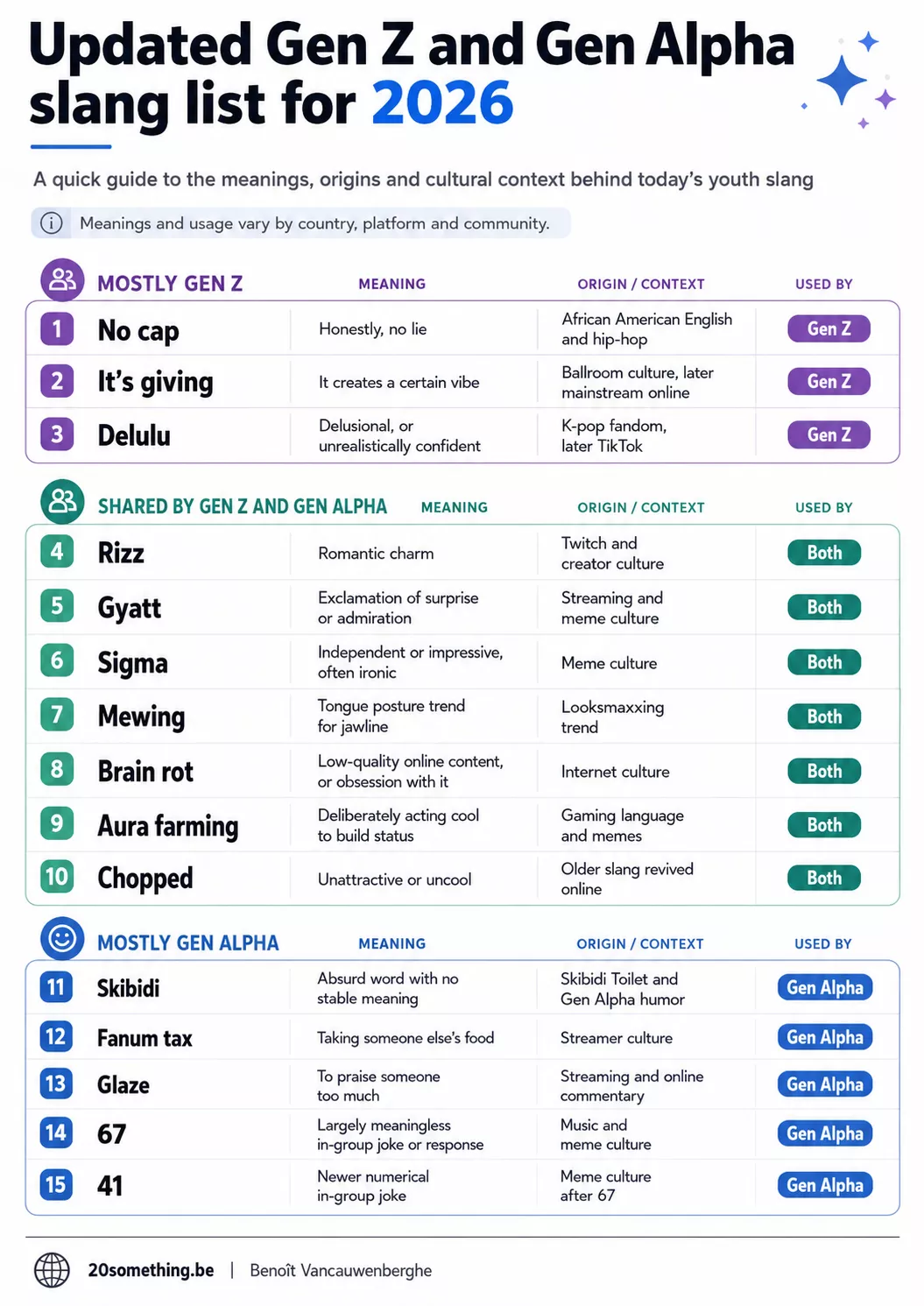
Gen Z and Gen Alpha slang words: the 2026 list
See here some slang words and phrases used by Gen Z and Gen Alpha. These terms may sound unfamiliar to older generations, but they have become a common part of everyday language for these young individuals.
Frequently asked questions about Gen Z and Gen Alpha slang
Gen Alpha slang is the evolving language associated with younger children and teenagers, particularly through TikTok, YouTube, gaming, Roblox and streaming culture. It often includes absurd, repetitive or deliberately meaningless expressions.
Gen Z slang often uses irony, commentary and references to identity, emotions and online culture. Gen Alpha slang tends to include more gaming language, streamer references, rapid meme combinations and absurdist “brain rot” humor. The two frequently overlap.
Youth slang can originate in music, African American English, queer ballroom culture, fandoms, gaming, livestreams, schools and niche internet communities. Social platforms then accelerate its distribution.
Algorithms, creator culture, and short-form video can make a term globally visible within days. Once the expression becomes mainstream, its original users may adapt it, use it ironically, or move towards a newer code.
“67” does not have one fixed definition. It is a meme expression, random response and social signal that became popular among Gen Alpha and younger teenagers. Its value comes primarily from recognising the reference.
Usually, brands should understand Gen Z slang without trying to imitate it. Slang can work when it emerges naturally from the brand’s community, but forced usage often appears outdated or inauthentic.
Understand the signals behind the slang
Youth slang changes quickly, but the cultural shifts behind it run much deeper. Understanding Gen Z and Gen Alpha means recognizing how they build identity, belonging and trust across new communication systems.
In his keynotes, Benoît Vancauwenberghe helps leaders and brands decode these signals and translate them into more relevant communication, stronger workplace cultures and better strategic decisions.

You may also like these articles
Explore our collection of articles decoding youth culture, Gen Z, and Gen Alpha.